


Denial Management in Medical Billing: How Private Practices Stop Losing Revenue
When an insurance payer rejects a claim, it does not simply disappear. It sits in a queue, aging, while your practice waits on money it has already earned. For hospitals with entire billing departments, a denied claim is an inconvenience. For a privately owned practice running on tighter margins, it can be the difference between a profitable month and a cash flow crisis.
According to the American Medical Association, U.S. physicians spend an estimated $68,274 per year dealing with prior authorizations and claim-related administrative work. For small and independent practices, that number carries disproportionate weight. And yet denial management remains one of the most underfunded functions in private practice operations.
Denial rates across the industry average between 5% and 10% of submitted claims. Without a dedicated process to address them, most practices recover less than half of what they are owed.
Why Private Practices Are Most at Risk?
Large health systems have revenue cycle departments with specialists assigned to nothing but denial follow-up. Independent and small group practices typically cannot afford that staffing model. A front-desk administrator, a part-time biller, or a physician doubling as a practice manager is handling tasks that require specific payer knowledge, tight timelines, and persistent follow-through.
The result is predictable. Denials that require a 30-day response window get missed. Claims that need supporting documentation sit untouched. Payer-specific appeal requirements go unmet. Over time, write-offs accumulate, and the practice normalizes a level of lost revenue that should never have been accepted in the first place.
This is exactly why having a dedicated company or professional managing denials is not a luxury for privately owned practices. It is a core operational requirement.
The Root Causes of Claim Denials
Credentialing and Contracting Gaps
One of the most preventable causes of denied claims is incomplete or lapsed provider credentialing. If a physician is not properly enrolled with a payer or contracted under the right NPI, every claim submitted to that payer will be rejected before a reviewer ever looks at the clinical details.
Credentialing is not a one-time process. Payers require re-credentialing on a cycle, and contracts need active management to reflect updated fee schedules, added providers, and service changes. When those renewals slip through the cracks, the practice keeps billing and payers keep denying, often for months before anyone identifies the source of the problem.
AlphaMed Solutions handles the full credentialing and contracting process, from initial enrollment through ongoing renewal management. Getting this right upstream eliminates an entire category of denials before they are ever submitted.
Learn more about our credentialing and contracting services.

Coding and Documentation Errors
Incorrect CPT or ICD-10 codes, missing modifiers, and mismatched diagnosis-to-procedure pairings account for a significant share of denials. These errors are rarely intentional. They happen when clinical staff are coding under time pressure or when billing software is not updated to reflect payer-specific requirements.
A dedicated billing team brings current coding expertise and payer-specific knowledge that in-house staff, especially in single-specialty or small practices, cannot reasonably maintain alongside their primary responsibilities.
Eligibility and Authorization Failures
Claims denied for eligibility issues or missing prior authorizations are particularly frustrating because the services have already been provided. Catching these before the patient is seen requires a verification workflow that many practices do not have time to operate consistently.
What Denial Management Actually Involves
Effective denial management is not just about appealing rejected claims. It is a full-cycle process that includes identifying denial patterns, correcting root causes, resubmitting with complete documentation, tracking outcomes, and reporting trends back to the practice.
When done properly, denial management also provides intelligence. If a specific payer is rejecting a particular procedure code at a high rate, that is a signal worth acting on, whether through documentation improvement, a coding audit, or a direct conversation with the payer representative.
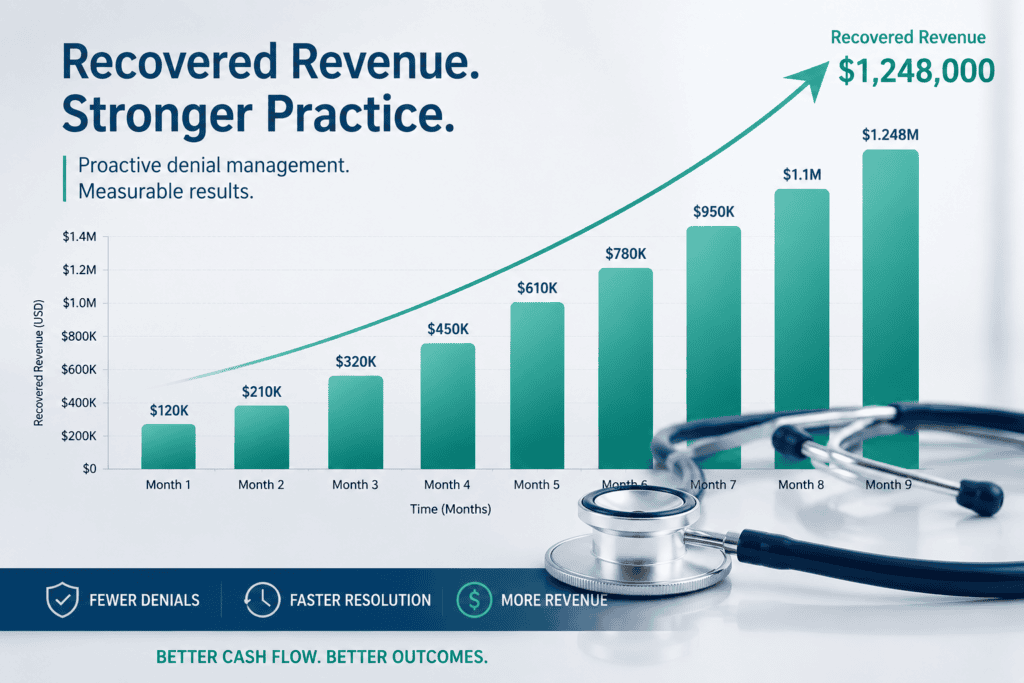
AlphaMed Solutions manages the complete denial workflow, from follow-up on individual claims to aggregate reporting that gives practice owners visibility into where revenue is leaking and why. Practices that outsource billing to a company equipped to do this work see measurable improvements in net collection rates, often within the first 90 days.
See how our medical billing services address denials at every stage of the revenue cycle.
The Financial Case for Outsourcing Medical Billing
The cost argument for outsourcing is straightforward. Hiring a full-time, experienced billing specialist in the United States carries a median salary between $45,000 and $60,000 annually, plus benefits, training, and software licensing. That same investment, directed toward an outsourced billing partner, typically yields higher claim volume capacity, broader payer expertise, and dedicated denial management, without the overhead of a direct employee.
For practices generating between $500,000 and $3 million in annual revenue, the math is especially clear. A billing company working on a percentage-of-collections model is directly motivated to recover every dollar possible. There is no incentive misalignment, no sick days leaving the billing queue unattended, and no knowledge gaps when staff turn over.
Private practices that outsource billing consistently report reductions in denial rates, faster days in accounts receivable, and more time available for clinical operations.
Beyond denials specifically, outsourcing addresses the full revenue cycle: eligibility verification, charge entry, claims submission, payment posting, patient balance follow-up, and reporting. Each of those functions requires attention that a practice owner focused on patient care cannot reasonably provide in-house at the level needed to compete.
Credentialing as a Revenue Protection Strategy
Practices that treat credentialing as an administrative afterthought tend to discover its importance at the worst possible moment, when a new provider has started seeing patients but cannot bill for those visits, or when a re-credentialing deadline passes and claims begin systematically denying.
Getting contracted with the right payers, at the right fee schedules, with all active providers properly enrolled, is the foundation on which every other billing function depends. A well-managed credentialing program means clean claims go out the door from day one, and denials rooted in enrollment problems never enter the system.
For practices adding new providers, changing locations, or expanding into new specialties, active credentialing and contracting support is particularly valuable. The timeline from application to approval with major payers can range from 60 to 120 days. Managing that process without dedicated expertise typically means delays, and delays mean lost revenue.
What to Look For in a Billing Partner
Not all medical billing companies are the same. For privately owned practices, the right partner should have experience across multiple payers and specialties, transparent reporting, a clear process for denial follow-up, and the capacity to manage credentialing alongside billing. A company that handles both under one roof eliminates the coordination gap that often exists when practices use separate vendors for each function.
AlphaMed Solutions works with practices across 30 specialties in more than 50 states. The team manages the entire revenue cycle, including credentialing, contracting, denial management, and reporting, with a model built around smaller practices that need enterprise-grade billing expertise without enterprise overhead.
Stop Writing Off Revenue You Have Already Earned
Every denied claim that goes unaddressed is money your practice earned but never collected. AlphaMed Solutions manages your entire billing cycle, including credentialing, denial follow-up, and revenue reporting, so you can focus on patients while we protect your bottom line.
Request a Free Practice Analysis at AlphaMedSolutions.com
Private practices that stay financially healthy in a complex payer environment do so through intentional systems, not optimism. Denial management, credentialing, and professional billing are not nice-to-haves. They are the operational infrastructure that makes everything else possible.